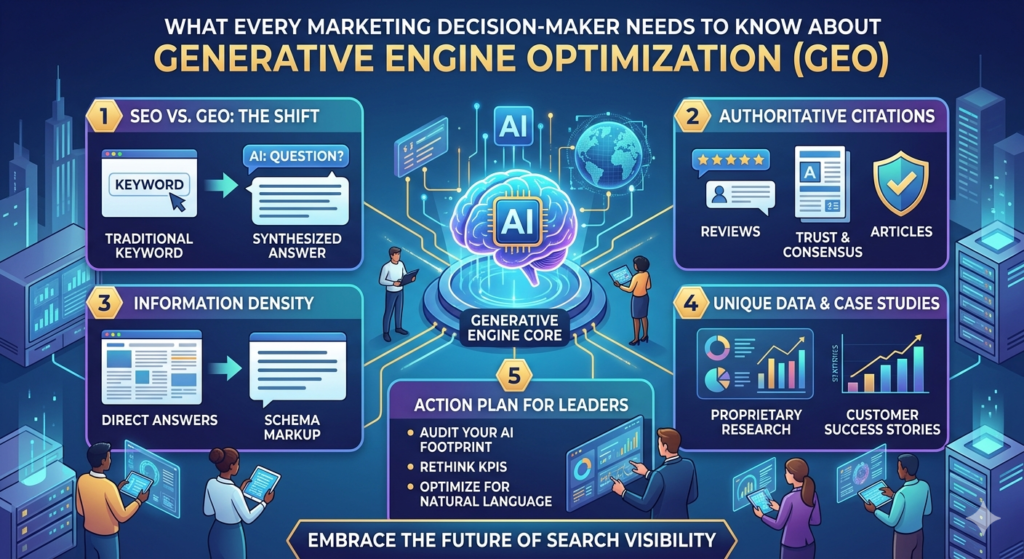
What Every Marketing Decision-Maker Needs to Know About Generative Engine Optimization
The digital marketing landscape is experiencing its most profound disruption since the inception of the commercial search engine. For over two decades, the playbook for online visibility was straightforward: optimize for keywords, build backlinks, and rank in the top ten blue links on Google.
Today, that playbook is rapidly becoming obsolete.With the rise of Google’s AI Overviews, OpenAI’s SearchGPT, Perplexity, and conversational bots like ChatGPT and Gemini, user behavior has fundamentally shifted. Consumers are no longer just searching for links; they are asking complex questions and expecting synthesized, instant answers. This shift has birthed a new imperative for marketing leaders: Generative Engine Optimization (GEO). For CMOs, marketing directors, and business owners, understanding GEO is no longer an forward-looking luxury—it is a matter of immediate survival.
What is Generative Engine Optimization (GEO)?
While Search Engine Optimization (SEO) focuses on ranking high on traditional search engine results pages (SERPs), GEO is the practice of optimizing your brand’s content so that artificial intelligence models cite, recommend, and include your business in their synthesized responses.When a user asks an AI engine, “What is the best enterprise CRM for a remote sales team, and why?” the engine does not return a list of websites. It scours its training data and the live web, analyzes the options, and generates a cohesive response, complete with inline citations. GEO is the strategic process of ensuring your brand is the one being recommended and cited in that generated text.